In This Article
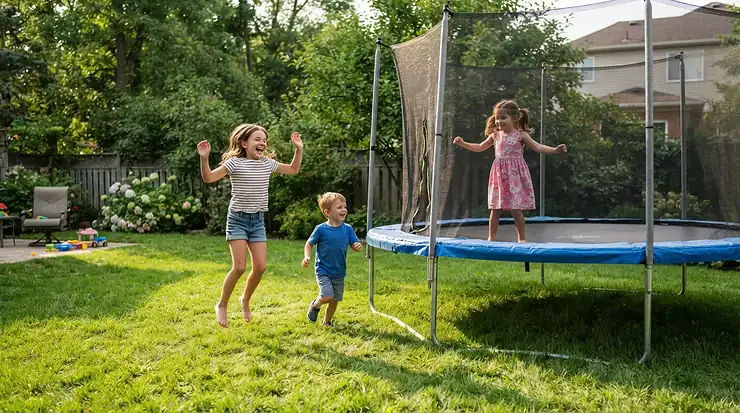
Here’s an uncomfortable truth about backyard trampolines: the springs and frame are the parts that hurt people, and the pad is the only thing standing between a jumper and cold steel. The U.S. Consumer Product Safety Commission says padding must completely cover the springs, hooks and frame. Sun, rain, and one summer too many will chew through the original pad faster than most owners expect. So round trampoline safety pads replacement isn’t a cosmetic upgrade. It’s maintenance on the one component that exists purely to prevent injury.
The catch is that the replacement market is a maze. Listings say “universal,” yet pad width, foam thickness, and spring-length limits vary a lot. A cover that’s perfect for a 12-foot frame with 7-inch springs can leave gaps on a frame with 8.5-inch springs. And “UV-resistant vinyl” gets printed on nearly every box, whether the material is thin or genuinely heavy.
This guide cuts through that. I compared seven real, widely sold pads on their published specs, material weights, and the review patterns that show up across retailer listings. Then I turned those findings into practical advice on pad measurement, spring cover diameter, spring-length limits, and the maintenance habits that make a pad last. A quick note: I haven’t physically tested these products, so everything here comes from specs and aggregated reviews, and I’ll say so whenever the evidence is thin.
Quick Comparison: Round Trampoline Safety Pads Replacement at a Glance
| Product | Best For | Foam / Pad Width (as listed) | Rating Signal (retailer listings) |
|---|---|---|---|
| SkyBound Universal Replacement Trampoline Pad | Buyers who want published fit limits | 0.5 in foam; 10 in width (12-14 ft) | Small review pool, around 4.0 |
| Upper Bounce Super Spring Cover | Mainstream, easy-to-find fit | 0.5 in foam; elastic straps with S-hooks | About 4.5 across roughly 33 ratings |
| Upper Bounce Premium Replacement Pad | Heavy sun and weather exposure | 0.75 in foam; 450g PVC top | 4.9 on a small pool |
| ExacMe Round Spring Cover | Gap-free coverage | 12.2 in pad width; inner and outer tie-downs | About 4.5 across roughly 38 ratings |
| Yescom Universal Round Safety Pad | Budget one-piece cover | One-piece PVC and EPE design | About 4.2 on a small pool |
| Aoodor Universal Safety Pad | Lowest-cost entry | Verify thickness on the listing | Too thin to rate |
| Gymax Universal Split Spring Cover | Easier installation | Split design with hook-and-loop | Not verified |
Looking at the table, the Upper Bounce Premium Replacement Pad is the standout on paper for durability, while the Yescom Universal Round Safety Pad and Aoodor Universal Safety Pad are the cost-first picks. Notice how thin the review pools are on several of them. A 4.9 from a handful of ratings tells you less than a 4.5 from dozens, so weight the numbers accordingly. The Gymax Universal Split Spring Cover is the odd one out, built around how it goes on rather than how thick it is.
💬 Just one click — help others make better buying decisions too!😊
Top 7 Round Trampoline Safety Pads Replacement Picks: Expert Analysis
Before the individual write-ups, here’s how the field compares on price and fit. Prices are approximate ranges seen across retailers and shift by size, color, and seller, so check the current price before buying.
| Product | Approx. Price Range | Spring-Length Fit | Standout Material Detail | Best For |
|---|---|---|---|---|
| SkyBound Universal Replacement Trampoline Pad | $80-$100 range (12-14 ft) | Up to 7 in (12-14 ft) | PVC top, PE bottom, drainage holes | Careful, spec-driven buyers |
| Upper Bounce Super Spring Cover | $85-$110 range | Check listing | 310g PVC, 130g PE | Mainstream replacement |
| Upper Bounce Premium Replacement Pad | Check current price | Check listing | 450g PVC, 310g PE | Harsh climates |
| ExacMe Round Spring Cover | $50-$110 range by size | Check listing | 12.2 in width, inner tie-downs | Gap-averse parents |
| Yescom Universal Round Safety Pad | $50-$70 range (12 ft) | 6.5-7 in (12 ft) | One-piece, foldable | Budget buyers |
| Aoodor Universal Safety Pad | $40-$55 range | Check listing | Waterproof, no pole holes | Tight budgets |
| Gymax Universal Split Spring Cover | $70-$80 range (15 ft) | Check listing | Split design, hook-and-loop | Solo installers |
The pattern is predictable. Spending more generally buys heavier material weight and thicker foam, while the budget tier saves money by thinning both. The cleverest value plays sit in the middle, where published specs make the extra spend visible.
1. SkyBound Universal Replacement Trampoline Pad — most transparent fit specs
This is the pad for people who like numbers. SkyBound publishes pad width, skirt width, and maximum spring size on the product page, which most universal-pad sellers don’t bother to do.
The 12- and 14-foot versions list a 10-inch pad width, a 4-inch skirt, and a 0.5-inch solid closed-cell foam layer, with a stated limit of 7-inch springs. The 15-foot version widens to 12 inches for up to 8-inch springs. The spring ceiling matters most here: a pad that’s too narrow for your spring length leaves the hooks exposed, which defeats the purpose. The shell is high-density PVC over PE with a UV-resistant coating, plus drainage holes so water doesn’t pool.
One honest wrinkle: SkyBound‘s own pages state this standard pad isn’t compatible with SkyBound trampolines. It’s built for other brands.
Review-wise, the verifiable pool I found is small, with ratings around 4.0 on one retailer listing, so treat the numbers as directional only.
Pros:
- ✅ Fit limits published clearly before you buy
- ✅ Drainage holes reduce standing water
- ✅ Wider 12 in version available at 15 ft
Cons:
- ❌ Not compatible with SkyBound trampolines
- ❌ Small review pool limits confidence
Expect an $80-$100 range for 12-14 ft sizes; a fair price for the transparency.
2. Upper Bounce Super Spring Cover — the easy-to-find mainstream fit
Think of the Upper Bounce Super Spring Cover as the default answer. It’s stocked widely, comes in many sizes, and its spec sheet reads like the category average done properly.
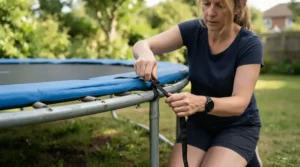
It pairs a 310g PVC top with a 130g PE underside over a 0.5-inch closed-cell EPE foam core. The elastic straps with S-hooks are the practical detail: they pull the pad snug against the frame instead of relying on loose ties that flap in wind. The listing also mentions a cold-weather crack-resistant coating, which matters if your trampoline stays up through winter.
Reviewers across retailers mostly describe a tight, correct fit, and one retailer’s summary credits it with hugging the springs. At least one reviewer called installation awkward, which is a fair warning: elastic straps ask for two people. Ratings sit around 4.5 across roughly three dozen ratings.
Note that some Upper Bounce pads only fit Upper Bounce’s own frames, so confirm compatibility.
Pros:
- ✅ Elastic S-hook straps keep the pad snug
- ✅ Many sizes and colors in stock
- ✅ Cold-weather crack-resistant coating
Cons:
- ❌ Install is easier with two people
- ❌ Some versions fit only Upper Bounce frames
Price runs roughly $85-$110; a solid, unremarkable-in-a-good-way value.
3. Upper Bounce Premium Replacement Pad — heaviest materials in this lineup
If your trampoline lives under unforgiving sun, this is the one worth a second look. The Upper Bounce Premium Replacement Pad simply uses more material than its sibling.
Per the 12-foot listing, the top is 450g PVC with a 310g PE bottom, and the foam is 3/4-inch EPE versus the usual half-inch. Material weight is the single best predictor of how long vinyl survives UV and flexing. Thicker foam also means a kinder landing if someone clips the pad. The closed-cell foam is described as resisting water, mildew, and shape loss.
The rating I found is 4.9 on a small number of retailer ratings. That’s encouraging but statistically fragile, so I’d call the durability story “promising on paper” rather than proven.
Who should buy it? Anyone in a high-sun or high-snow region who’s tired of replacing pads every couple of years.
Pros:
- ✅ Heaviest PVC and PE weights in this roundup
- ✅ 3/4 in foam cushions impacts better
- ✅ Water-resistant closed-cell core
Cons:
- ❌ Review pool is still small
- ❌ Fewer size options than the Super line
Check the current price; it generally sits above the standard line, and the extra material is where the money goes.
4. ExacMe Round Spring Cover — built to avoid the dreaded gap
Gaps are the hidden flaw of many pads, and the ExacMe Round Spring Cover is designed around fixing them.
The listing highlights a 12.2-inch pad width and tie-downs on both the inner and outer sides. That inner tie-down is the clever part: it stops the pad from sliding outward and uncovering the springs nearest the mat. The pad is also sold without slots for net poles, which simplifies things if your enclosure attaches elsewhere.
Reviewers mostly report good fits on 12- and 13-foot frames, and one summary mentions that the pad feels sturdy enough to walk on between springs. Ratings are around 4.5 across roughly 38 ratings. A fit warning applies: always match your frame diameter and spring length to the listing.
Pros:
- ✅ Inner and outer tie-downs reduce slipping
- ✅ Wide 12.2 in pad width
- ✅ Many sizes and color choices
Cons:
- ❌ No pole slots, which doesn’t suit every enclosure
- ❌ Price swings widely by size and seller
Prices range from about $50 to $110 depending on size and seller; compare sizes carefully.
5. Yescom Universal Round Safety Pad — one-piece budget cover
For buyers who want a straightforward pad without paying for extras, the Yescom Universal Round Safety Pad earns attention.
It’s a one-piece design in 310g/m² PVC with a 110g/m² PE layer and EPE foam. Spring compatibility is clearly stated: 6.5 to 7 inches on the 12-foot size, and 6.5 to 8.25 inches on the 15-foot. That range tells you something useful, because it means the pad isn’t meant for very short springs, which could leave the cover loose. Tool-free setup involves laying it flat and tying the straps to the frame, and it folds for storage.
The 12-foot listing shows about 4.2 across a small number of ratings. That’s decent but unproven at scale.
Pros:
- ✅ Clear spring-length range for each size
- ✅ Tool-free, tie-on installation
- ✅ Folds flat for off-season storage
Cons:
- ❌ Lighter PE layer than premium rivals
- ❌ Small review pool
Roughly $50-$70 for 12 ft. A good value if your spring length falls inside the stated range.
6. Aoodor Universal Safety Pad — lowest entry price
The Aoodor Universal Safety Pad is the budget gamble in this lineup, and I’d rather be upfront than pretend otherwise.
It’s marketed as a waterproof universal cover for round frames, carries a “best seller” tag on one retailer, and comes in sizes from 8 to 15 feet. What I couldn’t confirm is foam thickness and material weight, and those two numbers decide how long it lasts. Before buying, check the listing for them, and compare against the Upper Bounce Super Spring Cover weights above.
Review evidence is too thin to summarize. One 8-foot listing shows a single review, so I won’t pretend there’s a consensus.
Best fit: a lightly used trampoline, a short-term fix, or a buyer who plans to replace the pad again in a couple of seasons.
Pros:
- ✅ Among the lowest prices here
- ✅ Wide size range from 8 to 15 ft
- ✅ Waterproof marketing with color options
Cons:
- ❌ Foam and material weights unverified
- ❌ Almost no verifiable review history
Expect about $40-$55. Value verdict: fine for light use, risky if you want a pad that outlasts several summers.
7. Gymax Universal Split Spring Cover — easiest to install solo
Installation is where cheap pads go wrong, and the Gymax Universal Split Spring Cover attacks that directly.
Rather than one long ring, it uses a split design with hook-and-loop fasteners, sold in 14- and 15-foot sizes and marketed as waterproof. Sections let one person lay the pad around the frame piece by piece instead of wrestling a stretched ring over the springs. SkyBound’s two-piece 14- and 15-foot pads follow similar logic.
The trade-off is seams. Every joint is a place where sun and water can work in, and hook-and-loop closures can collect debris. I couldn’t verify material weights or review sentiment, so evaluate it on convenience rather than proven toughness.
Pros:
- ✅ Split design suits one-person installs
- ✅ Hook-and-loop closure at the joints
- ✅ Waterproof positioning
Cons:
- ❌ Seams add potential wear points
- ❌ Material specs and reviews unverified
Around $70-$80 for 15 ft. Verdict: worth it if install difficulty is your actual obstacle.
✨ Don’t Miss These Exclusive Deals!
🔍 Take your round trampoline safety pads replacement project to the next level with these carefully selected products. Click on any highlighted item to check current pricing and availability. These upgrades will help you create a safer jumping setup your family will love!
What Is Round Trampoline Safety Pads Replacement?
Round trampoline safety pads replacement is the process of swapping a worn or damaged spring cover on a round trampoline for a new one that matches the frame diameter and spring length. The pad covers the springs, hooks, and frame edge, cushioning accidental contact and shielding metal from sunlight and rain.
That definition sounds simple, but three terms deserve unpacking. The “pad” is a ring of foam sealed inside a vinyl shell. The “frame diameter” is the outside-to-outside measurement of the steel ring, which is the trampoline’s advertised size. And “spring length” is the hook-to-hook length of an unmounted spring, which sets how wide the pad must be.
Most replacement pads are sold as “universal,” meaning they fit multiple brands that share those dimensions. Brand-specific pads also exist, and they sometimes fit better because they match the manufacturer’s exact frame and pole layout. The practical takeaway: you’re really matching three numbers, not one.
How to Choose Round Trampoline Safety Pads Replacement
Picking well comes down to a short, ordered checklist. Work through it before you click anything.
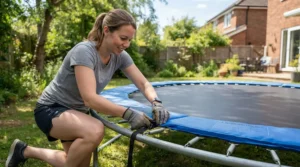
- Measure the frame diameter. Outer edge to outer edge, across the center. A 12-foot frame takes a 12-foot pad. Measure twice, as Springfree also advises.
- Measure spring length unhooked. A stretched, mounted spring reads long. Hook end to hook end, spring removed.
- Match pad width to spring length. A 10-inch pad is listed for springs up to 7 inches, per SkyBound‘s published limits. Longer springs need wider pads.
- Check material weights. Look for the PVC and PE weights. Higher numbers, like the 450g PVC on the Upper Bounce Premium Replacement Pad, signal sturdier vinyl.
- Check foam thickness. Half an inch is standard; 3/4 inch is a real upgrade.
- Confirm pole compatibility. Some covers have no pole holes, like the ExacMe Round Spring Cover, so make sure your enclosure suits that.
- Decide on one-piece or split. Split pads like the Gymax Universal Split Spring Cover install more easily; one-piece pads have fewer seams.
Reasoning matters here. Step three is where most buyers go wrong, because “fits 12 ft” says nothing about the spring ceiling.
Pad Measurement Guide: Getting Spring Cover Diameter Right
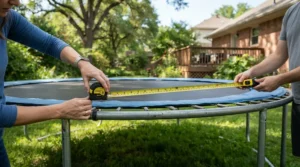
Good pad measurement takes ten minutes and prevents a return. You need a tape measure, a helper, and a level patch of ground.
Step 1: Frame diameter. Place the tape at the outer edge of the steel frame, run it through the center, and read the opposite outer edge. SkyBound suggests thinking of the frame as a clock: measure 12 to 6, then 3 to 9, and trust the number they agree on. Because a trampoline slightly out of round can skew one reading, the second pass is your safety net.
Step 2: Convert to spring cover diameter. The spring cover diameter on a listing equals your frame size. A 14-foot pad, for instance, appears on one retailer listing as a 168-inch circle, which is simply 14 feet times 12 inches. So when a listing gives inches, divide by 12 to compare against your frame.
Step 3: Spring length. Unhook one spring and measure it loose, end of hook to end of hook. Measuring a mounted spring overstates the length.
Step 4: Count the details. Note pole positions if you have an enclosure, and the number of springs for brand-specific pads.
Step 5: Common trap. Don’t measure the jumping mat or the old pad. A frequent mistake is measuring from the spring holes inward, which gives you the mat size, not the pad size. Old pads are often a few inches wider than the frame, so they mislead too.
Write the three numbers on a sticky note and keep it in your phone. You’ll thank yourself next time.
Replacement Spring Pad for Round Trampoline: Spring Length and Fit
A replacement spring pad for round trampoline frames succeeds or fails on one detail: whether the pad is wide enough to cover the springs it’s meant to protect. Frame diameter gets all the attention, yet spring length quietly decides coverage.
Here’s what the published specs imply. SkyBound Universal Replacement Trampoline Pad lists 10-inch widths for 12- and 14-foot frames with springs up to 7 inches, and 12 inches for 15-foot frames with springs up to 8 inches. Smaller 8- and 10-foot sizes are listed for springs up to 5.5 inches. The Yescom Universal Round Safety Pad gives a range of 6.5 to 7 inches for 12 feet, up to 8.25 inches at 15 feet.
What does that mean in practice? If your springs are longer than the pad’s ceiling, the pad’s inner edge sits too far out and exposes hooks near the mat. If they’re much shorter, the pad may overlap the mat excessively and shift.
When a brand won’t tell you the spring ceiling, treat that silence as information. Aoodor Universal Safety Pad and Gymax Universal Split Spring Cover listings required extra digging in my research, so confirm with the seller before ordering.
Round Trampoline Frame Pad Cover: What Full Coverage Means
A proper round trampoline frame pad cover does three jobs at once: it blocks the springs, hides the hooks, and wraps the steel frame. The CPSC’s guidance is explicit that padding must cover all three, not just the springs.
That’s where the skirt matters. The skirt is the downward flap, listed as 4 inches on SkyBound‘s pads, and it’s what wraps the frame’s outer edge. A short or loose skirt leaves frame tubing exposed on the side jumpers rarely look at, until someone slides off.
Color matters more than you’d expect. Under ASTM F381, frame padding is meant to contrast with the bed, which makes the edge visible to the jumper. Matching a black mat with a pale pad wouldn’t just be stylish; it’s functional.
Securing method is the other half. The ExacMe Round Spring Cover adds inner tie-downs, while the Upper Bounce Super Spring Cover relies on elastic straps with S-hooks. Either way, a pad that creeps outward during jumping creates the gap you bought it to prevent.
UV-Resistant Vinyl: What It Does and Doesn’t Do
“UV-resistant vinyl” appears on almost every listing, so it tells you almost nothing by itself. Vinyl here means PVC, and the useful questions are how heavy it is and how it was tested.
Material weight is the cleanest proxy. The Upper Bounce Super Spring Cover lists 310g PVC; the Upper Bounce Premium Replacement Pad lists 450g. More weight generally means more coating thickness to absorb UV and flex fatigue before it cracks. Some generic listings cite hours of accelerated UV testing, such as 2,000 hours on one 10-foot pad, though I can’t verify those claims independently.
Standards add context. ASTM F381 includes a UV-resistance test section for materials exposed to sunlight, according to its published scope and contents. Certification of a particular replacement pad isn’t guaranteed, so treat that as something to ask about rather than assume.
What UV resistance can’t do is make vinyl permanent. Reviewers of spring pads across brands note replacing them every couple of years because of sun deterioration. Resistance slows damage; it doesn’t stop it. Cold-weather crack-resistant coatings, like the one on the Upper Bounce Super Spring Cover, address the other end of the climate spectrum.
Features That Actually Matter (And Those That Don’t)
Marketing language inflates fast in this category, so let’s separate signal from noise.
Features that matter:
- Material weight (PVC and PE grams). It’s the closest thing to a durability number.
- Foam thickness. Half an inch is baseline; 3/4 inch genuinely adds cushioning.
- Published spring limit. Without it, you’re guessing at coverage.
- Securing system. Inner and outer ties, or elastic S-hooks, stop creeping.
- Drainage holes. SkyBound includes them to prevent pooling, which speeds mildew.
Features that matter less:
- Color names. “Maui Marble” looks great and protects the same.
- “Universal” as a word. It’s a starting claim, not a guarantee.
- Anti-fungal claims without detail. Helpful if true, hard to verify.
- Foldable packaging. Convenient but irrelevant to safety.
The test is simple: if a feature changes how the pad covers springs or how long the vinyl lasts, it matters. If it changes how the box looks, it doesn’t.

Real-World Scenarios: Matching Pads to Households
Specs are abstract until you picture a driveway. Here are three buyer profiles and how I’d reason through each.
The high-sun household in the Southwest. A family with a 14-foot trampoline, bright sun nearly year-round, and a pad that faded within two seasons. Material weight is the priority, so the Upper Bounce Premium Replacement Pad makes sense on paper, with its 450g PVC and 3/4-inch foam. The extra cost should spread across more seasons.
The renter with a short-term setup. One year in a rental, a 10-foot frame, kids who jump a few times a week. The Yescom Universal Round Safety Pad or Aoodor Universal Safety Pad keeps spending low, provided spring length falls inside the stated range.
The solo parent with a 15-foot frame. Installing a long elastic ring alone is genuinely hard. The Gymax Universal Split Spring Cover trades some seam durability for a far easier install. Pairing it with a careful annual inspection offsets the risk.
For anyone in between, the Upper Bounce Super Spring Cover and ExacMe Round Spring Cover are the sensible middle path.
Problem → Solution Guide for Pad Replacement
Most pad problems repeat across households. Here are the common ones with specific fixes.
Problem: the pad creeps outward and exposes springs. Fix: use every tie-down, including inner ones. The ExacMe Round Spring Cover adds them by design; on other pads, re-tie after the first week as straps settle.
Problem: water pools on top. Fix: choose pads with drainage holes, like the SkyBound Universal Replacement Trampoline Pad, and brush off debris after storms.
Problem: the pad is too short for the springs. Fix: remeasure an unhooked spring, then compare against the pad’s stated ceiling. If you’re over, size up to the wider 15-foot style if the frame allows, or choose another brand.
Problem: enclosure poles block the cover. Fix: check for pole slots before buying. No-hole styles suit external pole mounts; otherwise confirm the layout with the seller.
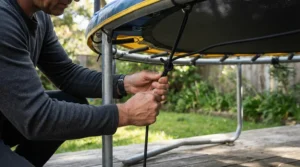
Problem: installation is a wrestling match. Fix: warm the pad in sun for a few minutes to soften it, work with a helper, or switch to a split design.
Round Trampoline Safety Pads Replacement vs Alternatives
Replacing the pad isn’t the only option, so compare honestly before committing.
| Option | Cost Level | Effort | Safety Outcome | Best For |
|---|---|---|---|---|
| Round trampoline safety pads replacement | Low-moderate | Moderate | Restores full coverage | Sound frame, worn pad |
| Patching or taping the old pad | Very low | Low | Uncertain, often incomplete | Short-term only, not recommended |
| Buying a brand-specific pad | Moderate-high | Moderate | Best fit for matching frames | Owners of branded models |
| Replacing the whole trampoline | High | High | New everything | Rusted frames or stretched mat |
The analysis is straightforward. If the frame, springs, and mat are healthy, a replacement pad is the cheapest way to restore safe coverage, and patching is a false economy that CPSC-style guidance wouldn’t endorse, since coverage must be complete. A brand-specific pad costs more but removes sizing guesswork. Replacing the trampoline only makes sense when rust or mat damage undermines the whole structure, because a fresh pad can’t compensate for compromised hardware.
Long-Term Cost & Maintenance
The sticker price of a pad hides its true yearly cost. A cover costing around $50 that survives two summers runs about $25 a year. One in the $90 range that lasts five works out near $18, and it asks fewer installation sessions of you.
That’s the logic behind paying for weight. The Upper Bounce Premium Replacement Pad‘s heavier vinyl is a bet on longevity, and the Yescom Universal Round Safety Pad is a bet on low upfront cost. Neither bet is automatically wrong; the better choice depends on your climate and how long you’ll keep the trampoline.
Maintenance extends either one. Brush off leaves, rinse grit that can abrade the vinyl, and check seams each spring. The AAP’s family guidance recommends replacing worn nets and pads before kids jump again. In winter, removing the pad or at least clearing heavy snow prevents stress cracking. Store it dry, folded loosely, and out of direct sun if you take it off.
Common Mistakes When Buying Pad Replacements
A few errors account for most disappointing purchases.
Trusting “universal” blindly. It means “fits many,” not “fits yours.” Verify spring ceiling and diameter.
Measuring the old pad. Old pads stretch and shrink. Measure the frame instead.
Ignoring spring length. This is the sneakiest mistake, since the diameter can match while coverage still fails.
Buying on color alone. Pretty pads with thin vinyl fade first.
Skipping the pole check. A no-hole cover and an enclosure that needs holes are a bad pairing.
Treating the pad as a complete safety system. The AAP has noted that safety measures haven’t substantially reduced injury rates, so a pad is one layer among supervision, one-jumper rules, and no somersaults. That honesty matters: replace the pad, but don’t let it lull you.
Safety, Standards & Regulations
Padding rules come from two places: federal guidance and voluntary standards. The CPSC reported an estimated 104,691 emergency-room-treated trampoline injuries in 2014 and lists falling on the springs or frame among the causes. Its advice is plain: pads must cover springs, hooks, and the frame.
ASTM F381 sets design and performance requirements for consumer trampolines, including how frame padding is attached and tested. Pads are expected to stay put under test, use UV-resistant materials where exposed to sunlight, and contrast with the bed. A replacement pad isn’t automatically certified just because the original trampoline was, so ask sellers directly.
Research on effectiveness is sobering. A peer-reviewed analysis in Injury Prevention set out to examine how well padding and enclosures work. And the AAP recommends against recreational home trampolines, while offering precautions for families who keep one. The takeaway is balanced: good padding is necessary, never sufficient. Supervision and rules do the heavy lifting.
FAQ
❓ How often should round trampoline safety pads replacement happen?
❓ Does a replacement spring pad for round trampoline frames fit any brand?
❓ What spring cover diameter do I need for a 12 foot trampoline?
❓ Is UV-resistant vinyl enough to stop a pad from fading?
❓ Can I use a round trampoline frame pad cover with no pole holes?
Conclusion
Round trampoline safety pads replacement comes down to matching three numbers: frame diameter, spring length, and the material quality you’re willing to pay for. Get those right and nearly every other decision follows.
If I had to sort the field: the SkyBound Universal Replacement Trampoline Pad wins on transparent specs, the Upper Bounce Super Spring Cover on easy availability, and the Upper Bounce Premium Replacement Pad on paper durability. The ExacMe Round Spring Cover is the one to consider if gaps worry you, and the Yescom Universal Round Safety Pad and Aoodor Universal Safety Pad are the budget lanes. The Gymax Universal Split Spring Cover earns its place only if installation is your real obstacle.
Remember the limits, too. A fresh pad doesn’t replace supervision, one jumper at a time, or a sound frame. But it’s the cheapest, fastest fix for the part most likely to fail first. Measure twice, check the spring ceiling, compare current prices, and your next pad should outlast the last one.
Recommended for You
- Round Trampoline vs Oval Trampoline for Families: 7 Best Picks, 2026
- Round Trampoline for Kids with Sensory Needs: 7 Best Safe Picks 2026
- Round Trampoline with Ladder for Young Children: 7 Best Picks 2026
Disclaimer: This article contains affiliate links. As an Amazon Associate, I earn from qualifying purchases. If you purchase products through these links, we may earn a small commission at no additional cost to you.
✨ Found this helpful? Share it with your friends! 💬🤗
