In This Article
Walk into a home with a sensory-seeking child and the evidence is everywhere. The couch cushions are flattened, the bed has become a launchpad, and a small person runs on a battery nobody can find the off switch for. That urge to crash, climb and bounce isn’t mischief. For many kids it’s the nervous system asking for input. A round trampoline for kids with sensory needs gives that urge a safe place to land.
Here’s the catch: the market is crowded with look-alikes. Some are wobbly, some squeal like a rusty gate, and some have a weight limit your growing kid will blow past by next birthday. This guide sorts seven real models by what actually matters: stability, noise, weight capacity, handlebar design and how long the thing will survive daily use. Everything below comes from spec sheets, retailer listings and aggregated buyer reviews. It does not come from a hands-on test lab, and I’d rather say so than fake it.
A quick framing note. Sensory processing differences are widely discussed in occupational therapy circles and summarized on Wikipedia, though the label itself remains debated in medicine. Every child responds differently, so treat this article as a buying guide and not a prescription. Prices are ranges only, because they shift constantly. Check current price before you buy.
Quick Comparison: 7 Round Trampolines at a Glance
| Product | Size & Shape | Listed Weight Limit | Price Range | Best For |
|---|---|---|---|---|
| Little Tikes 3′ Trampoline | 36″ round | 55 lb | $70-$85 range | Preschool first-timers |
| Skywalker 36″ Round Mini Hopper | 36″ round | About 60 lb | $50-$65 range | Tight budgets |
| Fisher-Price WonderJump 3ft | 36″ round | 55 lb | Under $100 tier | Hard floors, easy setup |
| Sportspower My 1st Trampoline 36″ | 36″ round | 220 lb | $50-$65 range | Bigger, heavier kids |
| SkyBound 36″ Trampoline with Handle | 36″ round | Listed up to 220 lb | $55-$65 range | Sturdy-frame seekers |
| Skywalker 60″ Round Indoor with Enclosure | 60″ round | 100 lb | $100-$150 range | Kids who like a “den” |
| JumpSport 220 | 39″ round | Roughly 225-250 lb | $150-$270 range | Older kids and teens |
Look at the weight-limit column first, because that’s where most buyers go wrong. The three smallest-capacity models are lovely for preschoolers but have a short shelf life. The Sportspower My 1st Trampoline 36″ and SkyBound 36″ Trampoline with Handle cost about the same and carry roughly four times the load. If your child is already heavy for their age, that single column outweighs every cute theme and color.
💬 Just one click — help others make better buying decisions too!😊
What Is a Round Trampoline for Kids with Sensory Needs?
A round trampoline for kids with sensory needs is a compact, padded, stable bouncing surface, usually 36 to 60 inches wide, built so a child can get rhythmic jumping input at home. A round mat tends to nudge jumpers toward the middle. Handlebars or enclosures add steadiness, and quieter bands or springs keep the bounce predictable. It supports, but never replaces, professional therapy.
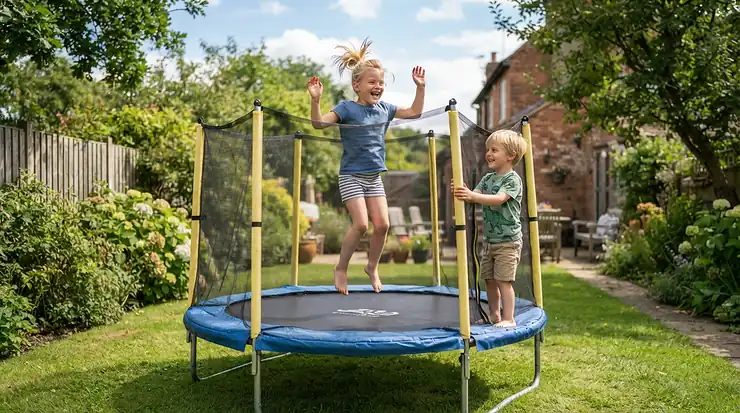
Why round, specifically? On a small mat, a round shape keeps a jumper centered, while corners on a square design invite stumbling toward the edge. It’s also easier to tuck into a playroom corner. The trade-off is jumping space. A 36-inch round gives a small child plenty of room and gives a nine-year-old almost none.
Top 7 Round Trampolines for Kids with Sensory Needs: Expert Analysis
1. Little Tikes 3′ Trampoline — the proven first bouncer for preschoolers
The headline here is track record. This is the model that shows up in countless playrooms, and its popularity tells you something.
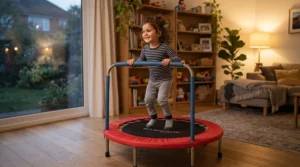
It’s a 36-inch round with a padded handlebar standing about 34 inches tall, a frame weighing roughly 13 pounds and a stated limit of 55 pounds. Light means you can move it from the living room to the bedroom in one trip. Light also means a heavy-footed stomper can walk it across a slick floor, so a rug or non-slip mat underneath is smart.
On paper, this suits a child aged roughly three to six who needs short, handlebar-supported bursts of jumping before dinner or after school. The manufacturer designates it for indoor use with one child at a time, which matches what I’d want for a sensory routine anyway.
Reviewer sentiment, as aggregated on Amazon-linked listings, is strongly positive. Tens of thousands of ratings average in the high 4s, and the recurring complaint is that kids outgrow the weight limit sooner than parents expect.
Pros:
- ✅ Handlebar height suits small preschoolers
- ✅ Lightweight and easy to relocate
- ✅ Huge pool of owner feedback
Cons:
- ❌ 55 lb cap means a short lifespan
- ❌ Can creep on slick floors
Expect to pay in the $70-$85 range. It’s fair value if your child is small, and poor value if they’re already near the cap.
2. Skywalker 36″ Round Mini Hopper — the budget pick with a quieter, band-based bounce
The standout feature is the stretch-band design. The listing describes 26 bands in place of metal springs.
That matters for two reasons. Bands generally mean fewer squeaks than rusty spring coils, and they remove exposed metal from the equation. The mat is 36 inches wide, and the padded handlebar helps younger kids find their balance. Retail listings give a weight limit near 60 pounds and a total weight of around 11 pounds, so it’s a featherweight.
Here’s my read. For a child who is noise-sensitive, a band system is worth the premium over a cheap spring model. For a heavier child, it’s a non-starter. I’d treat this as a try-it-first trampoline: a low-cost way to find out whether your kid actually likes bouncing before you invest in a sturdier setup.
Buyer sentiment on the no-spring version runs mostly positive, around four stars across several hundred ratings on a major retailer. The patterns in the reviews are mixed on handlebar durability and generally happy about price.
Pros:
- ✅ Band design reduces spring squeak
- ✅ Padded handlebar for steadier starts
- ✅ Very friendly price
Cons:
- ❌ About 60 lb limit
- ❌ Lightweight frame can shift
Plan on the $50-$65 range. As a starter model, the value verdict is solid.
3. Fisher-Price WonderJump 3ft — tool-free setup and grippy feet for hard floors
What sets it apart is the floor grip. Roundups describe six non-slip pads, which is exactly the feature a child who bounces with full-body commitment needs on tile or hardwood.
It’s a 36-inch round with a powder-coated alloy steel frame and a 55-pound limit. Reviewers often highlight tool-free assembly, which sounds minor until you’re building it at 9 p.m. with a child hovering. The handlebar detaches and the frame folds, so it can slide under a bed.
The practical upside is for families who need a trampoline that disappears between sessions. A visual schedule works well here: the trampoline comes out for “jump time” and goes away afterward, which can help with routine. I can’t verify much beyond roundup-level sentiment, so I’d lean on the spec sheet and read current retailer reviews before buying.
Roundups rate it among the top toddler models, and parents praise build quality. The main caveat is the same 55-pound ceiling.
Pros:
- ✅ Six non-slip pads grip hard floors
- ✅ Folds and detaches for storage
- ✅ Tool-free assembly
Cons:
- ❌ 55 lb limit
- ❌ Less review data than rivals
Expect it to land under the $100 tier at the time of research, so check current price.
4. Sportspower My 1st Trampoline 36″ — the 220-pound capacity that outlasts growth spurts
The attention-getter is capacity. The listing shows a 220-pound maximum, which is a different league from the 55-pound crowd.
It’s a 36-inch round with a no-gap padded cover and indoor/outdoor labeling. The no-gap cover matters for sensory kids who may bounce with their eyes closed or half-focused: it reduces the chance of a foot slipping between mat and frame. That 220-pound figure doesn’t mean it suits a big kid comfortably, though. The mat is still only 36 inches wide.
My take: this is the practical choice for a child who is heavy or tall for their age but still small enough to use a compact mat. Pair it with a rug and a hard rule of one jumper at a time.
Retailer ratings sit around 4.2 stars across a few hundred reviews, and positive comments mention that kids “can’t get enough” of it. Complaints are typical of budget trampolines: some units arrive with assembly quirks.
Pros:
- ✅ Very high listed weight capacity
- ✅ No-gap padded cover
- ✅ Wallet-friendly
Cons:
- ❌ Mat size stays small
- ❌ Variable fit-and-finish reports
Look at the $50-$65 range. For capacity per dollar, it’s hard to beat.
5. SkyBound 36″ Trampoline with Handle — a heavier frame aimed at daily seekers
SkyBound’s pitch is durability. The brand says it developed its sensory-focused line after hearing from parents and therapists that lighter models wouldn’t survive hours of daily use.
The 36-inch round lists a galvanized steel frame and a thick padded cover. The brand’s page lists weight capacity up to 220 pounds, though specs appear shared across several listings, so confirm the exact model before ordering. A heavier frame matters because it stays planted during energetic sessions.
I’d point this at the child who bounces for long stretches, because heavier hardware is the part most likely to hold up. The caveat is handlebar quality. On a related sensory-marketed SkyBound listing, one reviewer reported a handle snapping and leaving sharp edges, while another family loved the same product. That split is a reason to inspect hardware on day one.
Walmart-listed ratings for the 36-inch version hover around 4.2 across a few dozen reviews.
Pros:
- ✅ Sturdier steel frame
- ✅ Thick cover over hardware
- ✅ Strong capacity listed
Cons:
- ❌ Mixed handle-durability reports
- ❌ Spec details vary by listing
Plan for the $55-$65 range. Good value if the hardware holds up.
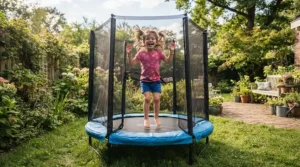
6. Skywalker 60″ Round Indoor Trampoline with Enclosure — a “den” for kids who crave containment
The unusual feature is the net. At 60 inches wide with a padded enclosure and zip door, this model turns jumping into something closer to a soft-walled pod.
For some children that containment is calming, a bit like a weighted blanket you can bounce inside. For others it’s overwhelming, so watch your child’s face the first time the zipper closes. The listing gives a 100-pound limit and an age range of roughly three to seven. Depending on the theme, the springs or bands differ, so verify the listing.
The wider mat gives a bigger child room to breathe. Reviewers describe it as sturdy and fun, with one noting the higher weight limit versus similar mini enclosures. The recurring negatives are assembly difficulty and a warning that bigger kids who bounce into the net can tip it.
Pros:
- ✅ Roomy 60-inch mat
- ✅ Enclosure adds containment
- ✅ Higher limit than most minis
Cons:
- ❌ Assembly is reportedly fiddly
- ❌ Needs floor space and clearance
Budget around $100-$150, then check current price. It’s good value if your child likes enclosed spaces.
7. JumpSport 220 — a quiet, premium rebounder for older kids and teens
The headline is the bounce quality. This 39-inch round fitness rebounder uses 30 low-impact bungee cords, which tend to feel smoother and run quieter than coil springs.
It’s built for adults, which is exactly why it matters: it’s one of the few options here that won’t bottom out under a ten-year-old. Listings cite roughly 225 to 250 pounds depending on the retailer, about 29.5 inches of jump space and a weight of around 21 pounds. The handlebar is an accessory, so budget for it. There’s no tension adjustment on this version, so the bounce firmness is fixed.
My read: this is the long-haul pick for a growing sensory seeker, and the one most likely to still be in use in three years. Retailer ratings run high, around 4.8 stars across a few dozen reviews, though the sample is small and largely adult-fitness buyers.
Pros:
- ✅ Quiet bungee-based bounce
- ✅ Handles older, heavier users
- ✅ Stable arched legs
Cons:
- ❌ Handlebar usually sold separately
- ❌ Price and no kid-specific padding
Count on the $150-$270 range, depending on retailer and bundle. It’s pricey, but cost per year of use can be the lowest here.
✨ Don’t Miss These Exclusive Deals!
🔍 Take your search for a round trampoline for kids with sensory needs to the next level with these carefully selected options. Click on any highlighted product name to check current pricing and availability. The right pick can help you create calmer, steadier bounce sessions your whole family will love!
Proprioceptive Input and Vestibular Stimulation: What the Bounce Actually Does
Two jargon words do a lot of work in sensory conversations, so let’s make them human.
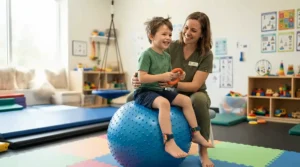
Proprioceptive input is the “heavy work” signal from muscles and joints that tells the brain where the body is. Every landing on a mat compresses the legs, hips and spine, and that compression is the input. Occupational therapists often describe this kind of input as organizing, and the advice that bounces around parenting circles is that it can feel grounding.
Vestibular stimulation comes from the inner ear, which tracks head position, gravity and movement. Occupational therapy guidance from NHS Wales lists trampoline bouncing among activities that engage both the proprioceptive and vestibular senses. As I read that guidance, rhythmic, linear movement tends to calm while faster rotary movement tends to alert, which is why a steady up-and-down bounce is a gentler choice than spinning.
A fair caution: the evidence is more clinical and anecdotal than ironclad. Individual responses vary, and some children find bouncing overwhelming rather than soothing. If your child pulls away, don’t force it. A therapist can help you decide whether a trampoline fits their profile.
Calming Trampoline for Sensory Seeking Kids: What to Look For
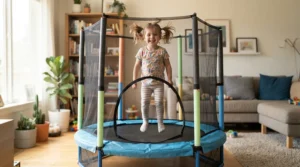
A calming trampoline for sensory seeking kids isn’t defined by marketing language. It’s defined by predictability. Here’s how the specs translate.
Noise. Squeaky springs are a sensory irritant for some kids. Band and bungee systems, like those on the Skywalker 36″ Round Mini Hopper and JumpSport 220, generally run quieter than coil designs. That doesn’t make them silent, but it removes one common trigger.
Stability. A wobble mid-bounce can turn calm into chaos. Heavier frames, like the SkyBound 36″ Trampoline with Handle, and grippy feet, like those on the Fisher-Price WonderJump 3ft, keep the surface predictable.
Containment. The Skywalker 60″ Round Indoor Trampoline with Enclosure offers a walled-in feel. Some kids settle into it like a nest, while others feel trapped. Introduce it slowly with the door open.
Visual calm. Busy prints can overstimulate. Muted colors and plain mats are easier on the eyes. Retail listings for Skywalker’s space-themed model, for instance, mention a muted palette.
The practical takeaway: pick the calm you can verify, such as noise, stability and containment, and ignore the adjectives on the box.
Round Trampoline for Autistic Children: Practical Considerations
A round trampoline for autistic children works best when it fits a routine, not just a living room. Predictability often matters as much as the bounce itself.
Start with routine. A visual schedule that shows “jump time,” then “snack,” then “quiet time” gives structure. Keep sessions consistent and supervised, as one retailer guide for sensory-focused trampolines also suggests.
Next, watch sensory responses. Some autistic children are sensory seekers who crave the input. Others are avoiders, for whom the motion, noise or touch of the mat is too much. Both are valid. A Springfree guide notes that bouncing can offer a calming effect for sensory regulation, yet other sources acknowledge that some people find the input overwhelming. If you see distress, stop and ask your child’s therapist.
Third, consider body size and communication. If your child can’t tell you something is wrong, a handlebar, a low height and constant supervision matter even more.
Finally, remember the limits. Trampoline use supports but does not replace speech, occupational or behavioral therapy.
How to Choose a Round Trampoline for Kids with Sensory Needs
Follow these seven steps, in order, before you click buy.
- Check the weight limit against growth. Choose a cap at least 30-40 pounds above your child’s current weight, so the trampoline doesn’t expire in a year.
- Measure the space. Leave about three feet of clearance on every side, as SkyBound’s own guidance recommends for its trampolines.
- Decide on handlebar or enclosure. A handlebar suits steadiness-seekers. An enclosure suits kids who want containment.
- Prioritize noise. If your child is sound-sensitive, favor bands or bungees over exposed coil springs.
- Inspect the floor grip. Rubber feet or non-slip pads matter on tile and hardwood.
- Read recent reviews for hardware complaints. Handle breakage, torn pads and assembly gaps are the common failures.
- Run it past your therapist. A short conversation can save you from a mismatch.
Features That Actually Matter (And Those That Don’t)
Let’s separate signal from marketing. What matters: weight capacity, frame stability, pad coverage with no gaps, handlebar strength and floor grip. These determine whether the trampoline is safe and survives daily use.
What doesn’t: themed mats, built-in sounds and cute animal prints. A dinosaur that roars every time your child lands may delight some kids and ruin the afternoon for others. If your child is sensitive to sound, a model with electronic effects, like Skywalker’s talking “Bounce-N-Learn” line, may be a poor match even if the reviews are glowing.
Maybe: adjustable-height handlebars. They sound great and do add flexibility as a child grows, but the extra joints are also extra failure points. Look at how the handle locks before you trust it.
The rule of thumb: the plainer the trampoline, the more predictable the experience. Sensory kids tend to thrive on predictable.
Therapy Bounce 101: A Practical Setup and Routine Guide
Here’s the part Amazon listings never give you. Think of a therapy bounce as a short, structured session and not a free-for-all.
Set up. Place the trampoline on a flat floor, away from furniture, with a rug or non-slip mat underneath. Tighten every bolt before first use and check them again after a week. Put it where you can see it from the kitchen, because supervision is the whole game.
Run a simple routine. Try three to five minutes of steady bouncing, a pause to drink water, then a calm activity such as a book or a squeeze with a pillow. A therapist can tailor timing, but short and consistent usually beats long and chaotic.
Mix input. Pair bouncing with other proprioceptive activities, like carrying a laundry basket, so the trampoline isn’t the only source of regulation.
Avoid the first-30-day mistakes. Don’t let siblings pile on. Don’t let kids attempt flips. Don’t leave a handlebar loose. CPSC guidance emphasizes supervising children on trampolines and having only one jumper at a time.
Maintain it monthly. Look for fraying bands, cracked pads and loose hardware. Replace worn parts before they fail.
Real-World Scenarios: Matching Kids to Trampolines
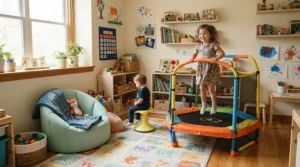
Three hypothetical profiles show how the choices play out.
The apartment preschooler. Picture a four-year-old on the second floor with a neighbor below. The priorities are quiet and floor grip. The Fisher-Price WonderJump 3ft or Little Tikes 3′ Trampoline, placed on a rug, fits. Budget: under $100. Use: two short sessions daily.
The sturdy seven-year-old. Imagine a child who weighs more than a typical small-trampoline limit allows and crashes into everything. The Sportspower My 1st Trampoline 36″ or SkyBound 36″ Trampoline with Handle offers capacity without a big spend. Budget: roughly $50-$65. Use: daily, supervised.
The den-seeker. Consider a child who retreats under tables and blankets. The Skywalker 60″ Round Indoor Trampoline with Enclosure may feel like a bouncing hideout. Introduce it gradually. Budget: $100-$150.
The growing ten-year-old. For long-term use, the JumpSport 220 with a handlebar can bridge childhood into the teens. Budget: $150-$270.
Round vs. Oval vs. Rebounder: Benefits vs. Traditional Alternatives
| Type | Typical Footprint | Strengths | Trade-offs | Best For |
|---|---|---|---|---|
| Round mini (e.g., Little Tikes 3′ Trampoline) | 36″ | Centers the jumper, fits small rooms | Limited jump space | Younger kids |
| Oval sensory (e.g., SkyBound Eos) | About 4 ft | Longer mat, purpose-built marketing | Not round; older SkyBound materials list 150 lb | Kids needing extra length |
| Fitness rebounder (e.g., JumpSport 220) | 39″ | Quiet bungees, high capacity | Often no kid padding or handle | Older kids and teens |
| Swing or crash pad | Varies | Different input type | No bounce | Kids who avoid jumping |
A round mini is the right default for most households. An oval can give a bigger child extra room, and the manufacturer says its Eos is built for hours of daily use. Fitness rebounders are quieter and sturdier but rarely designed with young children in mind. If you need an alternative to bouncing altogether, swings or crash pads provide different input.
Safety, Supervision, and What Pediatric Guidance Says
Time for the uncomfortable part. The American Academy of Pediatrics strongly discourages home trampoline use, and some summaries of its guidance include mini trampolines. Most injuries happen on the mat itself, and nets don’t prevent every one.
Federal data are sobering. The CPSC estimated more than 100,000 trampoline-related emergency-room injuries in 2014. Orthopaedic surgeons at the AAOS go further and advise that children under six shouldn’t use trampolines at all. That sits in tension with manufacturers who market to ages three and up.
How do you reconcile it? You reduce risk and make an informed choice. That means one jumper at a time, active supervision, no flips, regular equipment checks and a conversation with your pediatrician or occupational therapist. It also means checking whether your homeowner’s insurance covers trampoline injuries.
If your child is under six, treat this as a decision for you and your care team, not a default purchase.
Common Mistakes When Buying
Buying for today’s weight. A 55-pound limit can expire in a year. Buy for the child you’ll have, not the one you have.
Ignoring floor type. Slick floors turn light frames into sliding hazards.
Trusting “sensory” labels. The word on the box isn’t a certification. Check actual specs.
Skipping hardware checks. Several reviewers across brands report handle or assembly problems. Inspect everything on day one.
Letting siblings share. The AAP notes that most injuries happen with multiple users. Keep it to one. AAOS safety tips also caution against relying only on a net.
Using it as a babysitter. The point of the trampoline is regulation, and the point of supervision is safety. Neither works unattended.
Long-Term Cost and Maintenance
Cheap isn’t always cheap. Think in cost-per-year-of-use.
| Price Tier | Typical Range | What You Gain | Best For |
|---|---|---|---|
| Budget | $50-$65 | Entry-level, quick trial (Skywalker 36″ Round Mini Hopper, Sportspower My 1st Trampoline 36″) | Testing interest |
| Mid | $70-$150 | Better hardware or enclosure (Little Tikes 3′ Trampoline, Skywalker 60″ Round Indoor Trampoline with Enclosure) | Preschool to early school age |
| Premium | $150-$270 | Longer lifespan, quiet bounce (JumpSport 220) | Growing kids |
A $60 trampoline replaced after a year costs more over three years than a $200 one that lasts. That said, many kids lose interest, so a budget trial can be wise. Maintenance is mostly tightening bolts, checking pads, wiping surfaces and replacing worn parts.
FAQ
❓ How much does a round trampoline for kids with sensory needs cost?
❓ Can a 36-inch trampoline hold an older child?
❓ Do I need a handlebar?
❓ How long should a session last?
❓ What if my child seems overwhelmed by bouncing?
Conclusion
A round trampoline for kids with sensory needs can be a genuinely useful piece of home equipment, but only if the details line up. Start with the weight limit. Add stability, noise and containment. Then match everything to your child’s actual sensory profile, not the marketing.
For younger kids, the Little Tikes 3′ Trampoline and Fisher-Price WonderJump 3ft are tidy, familiar options. For tight budgets, the Skywalker 36″ Round Mini Hopper is a low-risk trial. If your child is heavier, the Sportspower My 1st Trampoline 36″ and SkyBound 36″ Trampoline with Handle offer more capacity. For kids who love a den, the Skywalker 60″ Round Indoor Trampoline with Enclosure may fit. And for the long haul, the JumpSport 220 is a premium rebounder that can grow with your child.
Above all, treat safety as non-negotiable. Pediatric guidance discourages home trampolines, so supervise closely, keep to one jumper and loop in your child’s care team. Bounce well.
✨ Ready to compare current prices and weight limits? 🔍 Click on any highlighted product above, check availability and pick the round trampoline your child can safely grow into!
Recommended for You
- Round Trampoline vs Oval Trampoline for Families: 7 Best Picks, 2026
- Round Trampoline Safety Pads Replacement: 7 Best Picks for 2026
- Round Trampoline with Ladder for Young Children: 7 Best Picks 2026
Disclaimer: This article contains affiliate links. As an Amazon Associate, I earn from qualifying purchases. If you purchase products through these links, we may earn a small commission at no additional cost to you.
✨ Found this helpful? Share it with your friends! 💬🤗
