In This Article
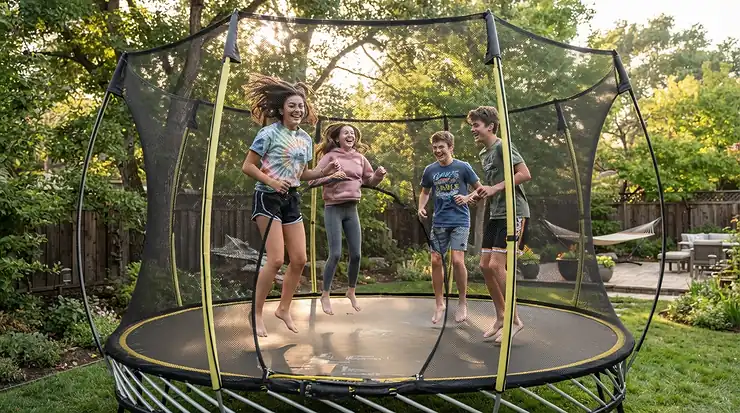
Every backyard trampoline debate starts the same way. One parent wants round, one wants oval, and neither can explain why beyond “it just looks right.” Here’s the thing: the choice between a round trampoline vs oval trampoline for families quietly decides how the mat throws your kids around, how much lawn vanishes, and how much room anyone actually gets to jump.
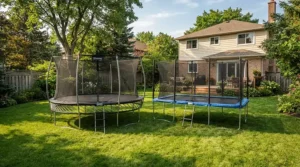
Round trampolines are the classic. Oval ones stretch that circle into a longer runway. Retail guides like this breakdown of round, rectangle and oval shapes describe round models as the soft, center-seeking option for casual play and ovals as the compromise that adds travel room without a rectangle’s bounce intensity. That’s the sales-floor summary. The useful version is what each shape means for a seven-year-old, a twelve-year-old, and a yard with a septic cover in one corner.
This guide covers the center bounce effect, the real difference in jumping surface shape, and the frame footprint each option claims. It also gives you seven real models across budget, mid-range and premium tiers. Prices appear as ranges only, because they move constantly. Check current prices before you buy.
Quick Comparison Table: 7 Trampolines at a Glance
| Product | Shape | Best For | Price Range |
|---|---|---|---|
| Skywalker 12′ Round | Round | Two younger kids on a budget | Roughly $200-$450 |
| JumpYeti 14′ Round | Round | Traditional family use | Mid-range |
| Zupapa 16FT Round | Round | Bigger kids who want space | Mid-range |
| Springfree R54 | Round | Small yards, little jumpers | Premium (four figures) |
| Skywalker 17′ Oval | Oval | Long yards, budget oval | Roughly $400-$500 |
| BERG Grand Champion | Oval | Narrow yards, shared play | Upper mid-range |
| Springfree O77 | Oval | Safety-first, long-term buyers | Premium (four figures) |
Read the table as a ladder. The round models cluster at the lower end of cost and footprint, while the ovals buy you length. The Skywalker 12′ Round wins on entry price, but the Springfree R54 and Springfree O77 show what you pay when you want springless design. Where the Skywalker 17′ Oval is concerned, the savings come with a longer assembly day.
💬 Just one click — help others make better buying decisions too!😊
Top 7 Round and Oval Trampolines for Families: Expert Analysis
Every entry below pairs real specs with what they mean in practice, plus aggregated review themes. Where independent reviews couldn’t be verified, I say so rather than guess.
1. Skywalker 12′ Round Trampoline with Enclosure — the budget-friendly starter round
Think of this as the sensible sedan of backyard trampolines. It’s not flashy, but it handles the daily grind.
The listing describes roughly 88 square feet of mat on a 12 ft frame, driven by 72 galvanized springs that sit outside the enclosure net. That matters because a foot can’t slip between the net and a bare coil. Retailer copy also describes a no-gap enclosure that interlocks with the mat, which removes a classic pinch point.
Based on the specs, a 12-footer is about the smallest size that works as a genuine family trampoline. It suits two younger kids taking turns, and the round frame’s center-seeking behavior forgives wobbly landings. Teens will outgrow it quickly.
Across roughly 1,350 ratings on one major retailer page, the average sits near 4.3 out of 5. Reviewers commonly call assembly straightforward but time-hungry (one report mentions about two and a half hours) and describe the quality as good for the price. Long-term durability beyond that is something I can’t verify.
Pros:
- ✅ Compact footprint suits average yards
- ✅ Springs sit outside the enclosure net
- ✅ Easy entry price for a full enclosure setup
Cons:
- ❌ Listed weight limits vary by version
- ❌ Assembly takes a full afternoon
Expect something in the $200-$450 range depending on retailer and color. Verdict: strong value if your kids are under ten.
2. JumpYeti 14′ Round with Safety Net — the “sweet spot” size for growing kids
If 12 feet feels cramped, 14 feet is the upgrade most guides land on. One retailer’s 2026 roundup calls a 14-foot round the “sweet spot” for families who want room to grow without swallowing the lawn. It names this model its best value-for-money pick for families.
The spec sheet is thinner here than for some rivals, so let’s reason from size. Going from 12 to 14 feet adds meaningful mat area, enough for a taller kid to bounce without feeling pinned in. The round shape still funnels jumpers toward the middle, which is why this size feels natural for ages roughly 6 to 12.
I couldn’t verify independent review volumes for this model, so treat the “best value” label as a retailer opinion rather than consensus. That’s worth knowing before you click.
Pros:
- ✅ Roomier than a 12-footer without oval sprawl
- ✅ Safety net included for fall protection
- ✅ Traditional round bounce suits mixed ages
Cons:
- ❌ Independent review depth is hard to confirm
- ❌ Larger footprint than 12 ft models
Price varies by retailer, so check current price; mid-range is the safe expectation. Verdict: a sensible middle path if reviews check out when you shop.
3. Zupapa No-Gap 16FT Round Trampoline — big-frame round with a no-gap seam
At 16 feet, you’re in large-yard territory. Listings advertise a patented no-gap seam where net meets mat, a 10-year frame warranty, and a headline 1,800 lb capacity.
Here’s the catch with that number: it’s static capacity, essentially what the frame can hold sitting still. It says little about the weight of jumpers bouncing, which is why dynamic limits are the more honest figure. Compare the dynamic rating before you buy.
Reviewers on third-party roundups rate this model highly, though several of those pages are affiliate sites, so weigh them with healthy skepticism. The more useful read is structural. A 16-foot round gives older kids real room, but the center bounce effect strengthens with size, so the middle becomes the place everyone drifts to.
Pros:
- ✅ Large mat for taller kids
- ✅ No-gap net seam reduces pinch points
- ✅ Long frame warranty on paper
Cons:
- ❌ Needs a big, level yard
- ❌ Static capacity figure is easy to misread
Mid-range pricing, and check current price. Verdict: worth it if you have the room and verify the dynamic limit.
4. Springfree R54 Compact Round — springless safety in a tiny footprint
This is the odd one out: no coils, no hard frame near the mat. Instead, flexible rods hold a soft net, and a retailer spec sheet lists the jumping area at about 4.9 square meters on a 2.5-meter mat.
That small mat packs more surface than the diameter implies. One retailer says its jumping surface is comparable to a 10 ft sprung round. The catch is that the retailer also warns the real space requirement is about double the diameter, because those rods flex outward. Plan for roughly a 5 by 5 meter clear zone.
It’s a good match for toddlers-turned-kindergartners and light users, with a listed European maximum user weight of 80 kg. Reviewer sentiment for Springfree in general trends strongly positive on quietness and perceived safety, but pricing is the repeated pushback.
Pros:
- ✅ No springs near the mat edge
- ✅ Soft flexing net rods absorb impact
- ✅ Gentle bounce suits small jumpers
Cons:
- ❌ Premium price for a small mat
- ❌ Needs more clearance than the diameter suggests
Expect a four-figure price, so check current price. Verdict: pay for it only if springless design is your priority.
5. Skywalker 17′ Oval Trampoline with Enclosure — the budget oval with 170 square feet
Here’s the oval that makes the case for the shape on price alone. A warehouse-club listing advertises 170 square feet of jumping surface, which is a big jump from a 12 ft round.
That extra length gives kids a runway for cartwheels, ball games and slam-dunk attempts, but it also creates two bounce zones instead of one. On paper this means siblings are less likely to collide than on a round, though it doesn’t make double-jumping safe.
Review themes are mixed in a useful way. Buyers praise the size (“perfect for our family,” in one paraphrase) and criticize the instructions, with repeated advice to watch a video before you start. One competitor’s blog also argues Skywalker’s bounce quality trails some rivals. Treat that as a competitor’s opinion, not an independent verdict.
Pros:
- ✅ Huge jumping surface for the price
- ✅ Long layout suits narrow yards
- ✅ Enclosure included in the package
Cons:
- ❌ Assembly instructions draw frequent complaints
- ❌ Bounce reputation trails premium brands
Roughly the $400-$500 range. Verdict: the best “more room per dollar” play here, if you can handle a long assembly day.
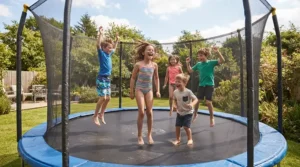
6. BERG Grand Champion 17′ Oval — V-spring layout built for narrow yards
This is the oval that fits tight spaces without feeling like a compromise. It uses BERG’s TwinSpring Gold system, where springs sit in a V pattern, which a retailer describes as creating a larger, more forgiving sweet spot in the center.
That’s useful because ovals often get criticized for lopsided bounce. A V-pattern aims to even out the center while the long axis gives travel room. A retailer’s 2026 guide names it a pick for space efficiency and performance.
BERG’s own information also notes the oval shape pulls jumpers toward the center, while another retailer says ovals bounce more evenly along the center line. Sources disagree on how strong that pull is, which is why you should treat any single claim cautiously. The practical takeaway is that ovals guide you gently along their long axis, not into one pinpoint.
Pros:
- ✅ Long jumping track fits narrow lots
- ✅ V-spring pattern widens the sweet spot
- ✅ Better for active kids than a round
Cons:
- ❌ Costs more than budget ovals
- ❌ Still a big structure to anchor
Upper mid-range pricing; check current price. Verdict: smart for tight yards with active kids.
7. Springfree O77 Medium Oval — the safety-design oval
The O77 is the oval that earns its premium through design. A major home-improvement retailer lists it at 8 ft by 11 ft with flexible composite rods, and the model was recognized in the Red Dot design awards for its safety-focused concept.
The mat is about 2.4 by 3.4 meters, and one European retailer lists a 10-year warranty for home use and a maximum user weight of 100 kg. Springfree’s own comparison notes that its square models have five sweet spots versus one on a round, so an oval lands in the middle with two.
Reviews for this model look strongly positive. One Australian review site shows about 4.9 out of 5 across roughly 300 reviews, with praise for quiet jumping and perceived safety. Cost is the recurring hesitation, and plenty of buyers say it was worth it in hindsight.
Pros:
- ✅ Springless design removes the biggest hazard
- ✅ Quiet, soft-feeling bounce
- ✅ Long warranty for home use
Cons:
- ❌ Premium pricing stings
- ❌ Heavy to move once installed
Expect a four-figure price, so check current price. Verdict: the best long-term pick if budget isn’t the limiter.
| Product | Standout Spec | Review Signal |
|---|---|---|
| Skywalker 12′ Round | 72 springs outside the net | Around 4.3/5 on a major retailer |
| JumpYeti 14′ Round | 14 ft size with net | Retailer’s value pick; independent reviews unverified |
| Zupapa 16FT Round | No-gap seam, long frame warranty | Affiliate roundups rate highly; verify |
| Springfree R54 | Springless, 4.9 m² mat | Strong sentiment, premium price |
| Skywalker 17′ Oval | 170 sq ft surface | Praised size, criticized instructions |
| BERG Grand Champion | V-pattern TwinSpring Gold | Retailer’s space-efficiency pick |
| Springfree O77 | Flexible rods, 10-year home warranty | About 4.9/5 on an Australian site |
Looking across the table, the sprung models trade hardware simplicity for lower cost, while the Springfree pair trades cash for a cleaner safety design. If you want the largest surface per dollar, the Skywalker 17′ Oval leads. If you want fewer hazards near the mat edge, the Springfree O77 and Springfree R54 are the clear leaders.
What Is the Difference Between a Round Trampoline vs Oval Trampoline for Families?
A round trampoline has a circular frame and mat that nudges jumpers toward one center sweet spot, giving a softer, more controlled bounce. An oval trampoline stretches that circle into a longer track with two sweet spots along its center line, adding travel room at the cost of a bigger footprint and, usually, a higher price.
That’s the snippet-friendly answer. The fuller picture is that shape changes three things at once: how the mat redistributes tension, how much usable space you get for the same frame width, and what each landing feels like. Round trampolines are the historic default, and ovals emerged as a roomier middle ground between round and rectangle.
Families usually decide on the kids’ ages, how many jumpers take turns, and the shape of the yard. We’ll walk through each of those next.
Center Bounce Effect: Why Round Trampolines Steer Kids Toward the Middle
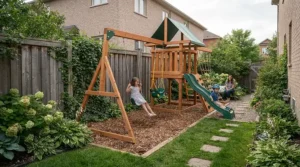
The center bounce effect is the reason round trampolines feel so forgiving. Because tension radiates evenly from every spring toward the middle, the mat dips deepest at the center, and anyone landing off-center gets nudged inward. Retail guides describe this as gentle and cushioned, which is why they recommend round models for younger kids and casual play.
There’s an upside and a downside. The upside: wobbly beginners rarely drift toward the net. The downside is that everyone drifts to the same spot, so two kids on a round are far more likely to meet in the middle. Safety groups warn against multiple jumpers precisely because collisions cause injuries.
On an oval, the center bounce effect gets spread along the long axis. One retailer describes ovals as bouncing evenly around the center line, with two jumping zones rather than one. A seasoned parent would say it this way: round trampolines herd, ovals suggest.
Jumping Surface Shape: Where an Oval Gives You Room Round Can’t
Jumping surface shape determines how much of the mat you can actually use. On a round trampoline, the best bounce lives near the middle, and the outer ring behaves stiffer. On an oval, you get an extended track, which is why retailers recommend it for cartwheels, ball games and basketball-style play.
A same-width oval simply offers more usable length. A 17 ft oval from Skywalker 17′ Oval advertises roughly 170 square feet, which is far beyond what a 12 ft round delivers. That extra space helps if your kids are active and older, but it can also encourage bigger, riskier moves.
This is also where the BERG Grand Champion earns attention. Its V-spring layout tries to enlarge the sweet spot, so the oval’s extra length doesn’t come with dead zones. Longer isn’t automatically better, but with sensible rules, a larger jumping surface shape reduces crowding, and crowding is the enemy.
Frame Footprint: How Much Yard Each Shape Really Claims
Frame footprint is where oval enthusiasts quietly lose arguments. A round trampoline needs a circle of clearance, while an oval needs a rectangle, and the rectangle is larger than you’d guess. Sellers note that ovals waste less “dead space” in long, narrow gardens, since the shape follows the yard instead of fighting it.
Clearance matters just as much as the frame itself. The Springfree R54 is a good example. Its 2.5-meter mat sounds compact, but one retailer notes the real space requirement is closer to double the diameter, because the flexible rods swing outward. A conventional frame needs similar clearance around nets and poles.
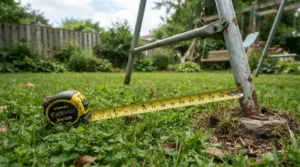
A rule of thumb: measure the footprint, then add safe fall zone on every side. If your yard is wide, a round wastes little. If it’s long and thin, an oval can use space that a round would leave empty. Don’t forget overhead branches, fences and utility lines.
Round or Oval Trampoline for Kids: An Age-by-Age Verdict
For a round or oval trampoline for kids, age drives the answer more than anything else. Retail guides pitch round trampolines for young children roughly ages three to ten, since the soft, center-guiding bounce is forgiving. Oval manufacturers tend to target kids over six who want room to travel, kick a ball or practice skills.
Safety groups add a harder line. Orthopedic specialists say children under six shouldn’t use trampolines at all, and the American Academy of Pediatrics discourages home use altogether. If you decide to buy anyway, treat that as the baseline for supervision rules.
Ages 6 to 9: a 12 to 14 ft round is the sweet spot, as the Skywalker 12′ Round and JumpYeti 14′ Round show.
Ages 10 to 13: an oval starts making sense, since longer jumps feel more natural. The Skywalker 17′ Oval suits active kids here.
Teens: a bigger oval like the BERG Grand Champion or Springfree O77 keeps them from outgrowing the setup.
Round Versus Oval Backyard Trampoline Shape: How Both Stack Up Against Rectangles
When people debate round versus oval backyard trampoline shape, rectangles quietly hover in the background. Here’s how the three compare.
| Feature | Round | Oval | Rectangle |
|---|---|---|---|
| Bounce feel | Soft, cushioned | Moderate, even | Highest, most powerful |
| Center-seeking | Strong | Moderate | Low |
| Footprint | Compact circle | Long, narrow | Largest |
| Typical cost | Lowest | Middle | Highest |
| Best For | Young kids, casual play | Active families, long yards | Teens, skill training |
The pattern is clear. Round trades power for control, rectangles trade control for power, and the oval sits in between, which is why many families land there. One retailer estimates rectangles run $100 to $500 above a comparable round, though that figure varies by brand and size.
If your kids are mostly under ten, the round shape is hard to beat. If you want room for older kids without paying for a rectangle, an oval is the compromise worth testing against your yard.
🔍 Compare current prices on these models and find the shape that fits your family best!
How to Choose Between a Round Trampoline vs Oval Trampoline for Families
- Start with your youngest jumper. If they’re under six, safety groups advise against trampolines entirely, so wait or discuss with your pediatrician.
- Measure your yard in two directions. A wide, square yard welcomes a round, while a long, narrow one rewards an oval.
- Count real jumpers. Plan for one at a time. If you want turn-taking sessions with several kids, extra mat area reduces waiting and crowding.
- Match shape to activity. Casual bouncing favors a round, while games and tricks favor an oval.
- Check dynamic weight limits. Static capacity is a marketing number. Look for the rated weight per jumper.
- Inspect the enclosure design. No-gap seams and springs outside the net matter more than color.
- Budget for the full setup. Anchors, a mat cover and replacement parts add up quickly.
Safety, Regulations and What the Experts Say
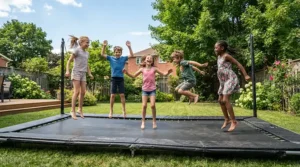
The American Academy of Orthopaedic Surgeons says more than 90 percent of trampoline injuries happen to children, mostly between ages 5 and 14. It also reports that more than half of injuries occur on the mat and that nearly three-quarters involve two or more children at once. The same group cautions that net enclosures don’t prevent most injuries, since most happen on the surface itself.
That’s a sobering lens for the shape debate. A round’s center bounce effect might reduce edge falls, but it doesn’t solve collisions. An oval’s extra room might reduce crowding, but it doesn’t make double-jumping safe.
The American Academy of Pediatrics goes further and strongly discourages home trampolines. If you proceed, treat the following as non-negotiable: one jumper at a time, active adult supervision, no flips, a level surface, and no ladder left in place when nobody’s watching.
Practical Setup and Maintenance Guide (First 30 Days)
Assembly is where good trampolines turn bad. Reviewers of both Skywalker 12′ Round and Skywalker 17′ Oval repeatedly mention long builds and confusing instructions, so budget a full afternoon and follow the video if the booklet frustrates you.
Setup tips:
- Pick a flat, soft-landing area away from fences, trees and sheds.
- Anchor the frame. A retailer story about a 14 ft model landing three yards away in a storm is a cautionary tale.
- Pad every spring, hook and pole joint.
Maintenance schedule:
- Weekly: check springs, net seams, and mat stitching.
- Monthly: retighten bolts and inspect padding.
- After storms: inspect for bent poles or stretched netting.
Health writers summarizing guidance from pediatric and orthopedic groups and the CPSC repeat the same advice, in this HealthDay summary: one child at a time, supervise, use a net, keep it level, and skip the ladder. Rules posted on the net itself keep everyone honest.
Real-World Scenarios: Which Shape Fits Which Family?
Scenario 1: Two kids, ages 7 and 9, average backyard, tight budget. The Skywalker 12′ Round is a reasonable fit. The shape keeps landings forgiving, and the lower price leaves room for anchors and a cover.
Scenario 2: Three kids, ages 8 to 13, long narrow lot. An oval makes the yard work harder. The Skywalker 17′ Oval gives the most surface per dollar, while the BERG Grand Champion offers a more refined spring layout.
Scenario 3: A family planning to keep the trampoline for ten years. The Springfree O77 is the long-game pick, thanks to its springless design and warranty. If space is tighter and kids are younger, the Springfree R54 keeps the safety concept in a smaller package.
Notice that none of these scenarios includes “everyone jump at once.” Even the best shape can’t repair bad habits.
Buyer’s Decision Framework: If This, Choose That
- If your yard is wide and square, choose a round, because it uses space efficiently.
- If your yard is long and narrow, choose an oval, since it follows the lot.
- If kids are under ten and mostly bounce, choose a round for its forgiving center.
- If kids are ten and up and love games, choose an oval for the travel room.
- If budget is the main limiter, start with the Skywalker 12′ Round.
- If safety design outranks cost, look at the Springfree R54 or Springfree O77.
- If you want the longest possible runway for the money, the Skywalker 17′ Oval is the cheapest route.
A quick gut check: if two or more of those bullets apply, rank them by safety first, space second, price third. Families who reverse that order often regret it.
Long-Term Cost and Price Range Value Analysis
Sticker price is only the opening bid. Total cost of ownership includes anchors, replacement mats, pads, nets and, for sprung models, eventual spring replacement.
| Tier | Example | Shape | Price Range | Best For |
|---|---|---|---|---|
| Budget | Skywalker 12′ Round | Round | Roughly $200-$450 | Younger kids |
| Budget | Skywalker 17′ Oval | Oval | Roughly $400-$500 | Surface-per-dollar shoppers |
| Mid-range | JumpYeti 14′ Round, Zupapa 16FT Round | Round | Mid-range | Growing kids |
| Upper mid | BERG Grand Champion | Oval | Upper mid-range | Narrow yards |
| Premium | Springfree R54, Springfree O77 | Round, oval | Four figures | Safety-first buyers |
The table shows that oval isn’t automatically the premium option, since the budget oval undercuts several rounds. Premium pricing comes from the springless engineering, not the shape. If you expect to replace a budget trampoline after a few seasons, a one-time premium purchase can level out over time, but that math depends on your household.
Frequently Asked Questions
❓ Is a round or oval trampoline for kids safer for beginners?
❓ How much space do I need around a trampoline?
❓ Do oval trampolines cost more than round ones?
❓ What size trampoline is best for a family with two kids?
❓ Can siblings share an oval trampoline safely?
Conclusion: Which Shape Wins for Your Family?
So, round trampoline vs oval trampoline for families: who actually wins? Round wins on forgiveness, price and compactness, which suits younger kids and smaller yards. Oval wins on room, flexibility and long-lot fit, which suits older, more active kids.
The center bounce effect is the heart of that split. A round steers jumpers inward, while an oval spreads the sweet spot along its length. Whichever you pick, measure your frame footprint honestly, respect the age guidance from medical groups, and keep jumping to one child at a time.
If budget leads, start with the Skywalker 12′ Round or Skywalker 17′ Oval. If you want the roomy oval with a refined spring layout, look at the BERG Grand Champion. If safety design outranks everything, the Springfree R54 and Springfree O77 are the standouts.
Recommended for You
- [Add your blog post link 1]
- [Add your blog post link 2]
- [Add your blog post link 3]
Disclaimer: This article contains affiliate links. As an Amazon Associate, I earn from qualifying purchases. If you purchase products through these links, we may earn a small commission at no additional cost to you.
✨ Found this helpful? Share it with your friends! 💬🤗
